How much you save with solar depends heavily on where you live. Your state’s electricity rate, available incentives, and net metering policy can mean the difference between a 7-year payback and a 15-year payback — for the exact same system.
This guide breaks down solar savings estimates for three of the most-searched states: Texas, Michigan, and New Jersey. Use our Solar Savings Calculator to get an instant estimate for your specific ZIP code and monthly bill.
Why Solar Savings Vary So Much by State
Three factors drive the difference:
- Electricity rate: States with $0.20+/kWh see much faster payback than states at $0.10/kWh
- State incentives: Tax credits, rebates, and SREC programs can reduce costs by thousands
- Net metering: Full retail-rate credit for exported power dramatically improves ROI
The federal 30% residential ITC expired December 31, 2025 — see our full ITC status guide for details. In 2026, state and local incentives are the primary financial levers for homeowners.
Solar Savings in Texas (2026)
Avg. electricity rate: ~$0.13/kWh
Avg. system cost (7 kW): ~$18,900
Avg. payback period: 10–13 years
What Incentives Are Available in Texas?
Texas has no state income tax, which means no state solar income tax credit. However:
- 100% property tax exemption on the added home value from solar (TX Tax Code §11.27 — file Form 50-123 with your county by April 30)
- Austin Energy rebate: $2,500 for eligible residential customers in Austin
- AEP Texas rebate: up to $3,000 for AEP service territory customers
- Net metering: Not mandated statewide — you must choose a retail electricity provider (REP) with a solar buyback plan. Buyback rates range from ~$0.03/kWh to full retail depending on your REP.
Texas Solar Savings Example
For a Texas homeowner with a $150/month electricity bill ($1,800/year):
| Amount | |
|---|---|
| 7 kW system gross cost | $18,900 |
| AEP/Austin Energy rebate (if eligible) | −$2,500 |
| Property tax exemption | ongoing savings |
| Estimated net cost | ~$16,400–$18,900 |
| Annual electricity savings | ~$1,200–$1,400 |
| Payback period | ~12–14 years |
| 25-year net savings | ~$30,000–$40,000 |
Best for: AEP Texas or Austin Energy customers, homeowners with high electricity consumption, those adding battery storage for grid independence after Winter Storm Uri.
Get your free Texas solar estimate → Use our Solar Calculator
Solar Savings in Michigan (2026)
Avg. electricity rate: ~$0.18/kWh
Avg. system cost (7 kW): ~$21,000
Avg. payback period: 10–13 years
What Incentives Are Available in Michigan?
- Full property tax exemption on solar system value (systems ≤150 kW)
- Sales tax exemption on solar equipment purchases
- Distributed Generation (DG) Program: Michigan replaced traditional net metering with a DG program — systems 20 kW or smaller receive full retail-rate credits for excess generation, carried forward to the next billing period
- Lansing BWL rebate: $500/kW up to $2,000 for Lansing Board of Water & Light customers
- Michigan Saves loans: low-interest financing at 4.44–7.90% APR for up to $50,000, terms up to 15 years
Michigan Solar Savings Example
For a Michigan homeowner with a $150/month electricity bill:
| Amount | |
|---|---|
| 7 kW system gross cost | $21,000 |
| Sales tax exemption (6% MI sales tax) | ~−$1,260 |
| Property tax exemption | ongoing savings |
| Estimated net cost | ~$19,740 |
| Annual electricity savings | ~$1,400–$1,600 |
| Payback period | ~12–14 years |
| 25-year net savings | ~$35,000–$45,000 |
Important: Michigan’s DG program credits at full retail rate for systems under 20 kW — which is essentially equivalent to traditional net metering for most residential systems. This makes Michigan more favorable than its moderate sun hours suggest.
Best for: Consumers Energy and DTE Energy customers, homeowners who want to lock in electricity costs as Michigan rates continue rising.
Get your free Michigan solar estimate → Use our Solar Calculator
Solar Savings in New Jersey (2026)
Avg. electricity rate: ~$0.18/kWh
Avg. system cost (7 kW): ~$22,750
Avg. payback period: 7–8 years
New Jersey is one of the best solar markets in the US — consistently ranking in the top 5 states for solar ROI even after the federal ITC expiration.
What Incentives Are Available in New Jersey?
- SuSI Program (Successor Solar Incentive): quarterly payments per kWh produced for 15 years — one of the most generous ongoing solar incentives in the country. Contact your installer for current SuSI rates.
- SREC market: earn Solar Renewable Energy Credits for each MWh your system produces, sold to utilities
- Retail-rate net metering: full credit for excess power exported to the grid
- Sales tax exemption on solar equipment
- Property tax exemption on the added home value from solar
New Jersey Solar Savings Example
For a New Jersey homeowner with a $150/month electricity bill:
| Amount | |
|---|---|
| 7 kW system gross cost | $22,750 |
| Sales tax exemption (6.625% NJ sales tax) | ~−$1,500 |
| SuSI program income (15 years) | significant ongoing income |
| Estimated net cost | ~$21,250 |
| Annual electricity savings | ~$1,400–$1,600 |
| SuSI/SREC annual income (est.) | $500–$1,500/year |
| Payback period | 7–8 years |
| 25-year net savings | ~$50,000–$65,000 |
Best for: JCP&L, PSE&G, or Atlantic City Electric customers. New Jersey’s SuSI program income on top of electricity savings makes it one of the fastest paybacks in the country.
Get your free New Jersey solar estimate → Use our Solar Calculator
State-by-State Comparison: Texas vs. Michigan vs. New Jersey
| Texas | Michigan | New Jersey | |
|---|---|---|---|
| Avg. electricity rate | $0.13/kWh | $0.18/kWh | $0.18/kWh |
| State tax credit | None | None | None |
| Best incentive | Property tax exemption + utility rebates | DG program + sales tax exemption | SuSI program + SREC market |
| Net metering | Varies by REP | DG (retail rate <20 kW) | Retail rate |
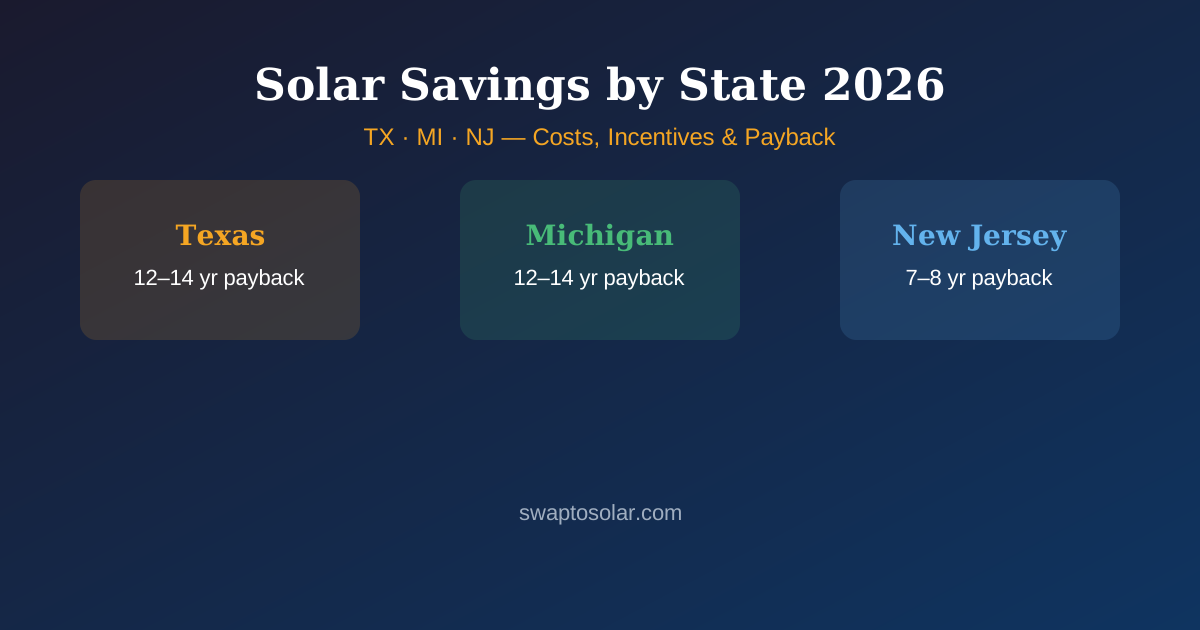
| Avg. payback (2026) | 12–14 years | 12–14 years | 7–8 years |
| Best for | Austin/AEP customers | Statewide | Statewide |
How to Get an Accurate Savings Estimate for Your State
The numbers above are averages. Your actual savings depend on:
- Your specific ZIP code (sun hours vary across a state)
- Your electricity rate (varies by utility within a state)
- Your roof orientation and size
- Which utility rebates you qualify for
Use our Solar Savings Calculator for an instant estimate based on your ZIP code and monthly bill. For more precise numbers, get quotes from 3+ local installers — prices vary 20–30% between companies.
For official sun data by location, use NREL’s PVWatts Calculator.
Key Takeaways
- Texas: No state credit, but property tax exemption and some utility rebates. Best for Austin Energy/AEP customers. Payback ~12–14 years.
- Michigan: Sales tax exemption, strong DG program, low-interest Michigan Saves loans. Payback ~12–14 years.
- New Jersey: Top solar state — SuSI program + SREC market + retail net metering. Payback ~7–8 years.
- In all three states, the federal residential ITC expired December 31, 2025 — state incentives are now the primary financial driver.
Browse Solar Savings by State
We publish in-depth, 2026-updated savings guides for individual states — each with local incentives, utility rules, net metering details, and a savings example:
- California — NEM 3.0, SGIP battery rebates, high-rate ROI
- Texas — property tax exemption, REP buyback plans
- Florida — net metering, tax exemptions, hurricane backup
- New York — 25% state tax credit (up to $5,000), NY-Sun
- New Jersey — SuSI / SREC-II production income
- Arizona — best US sun + 25% state tax credit
- Massachusetts — SMART program + 15% state credit
- Michigan — DG program, Michigan Saves loans
More states are added regularly. Don’t see yours yet? Use the Solar Savings Calculator for an instant estimate anywhere in the US.
Related Articles
- Solar Savings in California 2026: NEM 3.0 & Calculator
- Solar Savings in New York 2026: 25% State Tax Credit & Calculator
- Solar Savings in Florida 2026: Net Metering & Calculator
- Solar Savings in Michigan 2026: Costs, Incentives & Calculator
- Solar Savings in Texas 2026: Costs, Incentives & Calculator
- Community Solar 2026: What It Is & Which States Offer It
- Has the Federal Solar Tax Credit Expired? 2026 ITC Status Update
- Best States for Solar Energy in 2026: Top 10 Ranked
- How Much Do Solar Panels Cost in 2026? State-by-State Guide
- Solar Panels vs. Grid Electricity: Real Cost Comparison 2026
- Solar Savings Calculator
Sources: EnergySage Texas Solar Incentives, EnergySage Michigan Solar Incentives, EnergySage New Jersey Solar Incentives, DSIRE database, NREL PVWatts, EIA State Electricity Profiles.