California is the largest residential solar market in the United States — and despite the end of the federal ITC in 2025 and the move to NEM 3.0, it remains one of the most financially compelling states to go solar. The reason is simple: California has some of the highest electricity rates in the country (often $0.30–$0.45/kWh), so every kilowatt-hour your panels produce offsets an expensive utility bill.
Use our Solar Savings Calculator to get an instant estimate based on your California ZIP code and monthly electricity bill.
California Solar at a Glance (2026)
| Factor | California 2026 |
|---|---|
| Avg. electricity rate | ~$0.31/kWh (among the highest in US) |
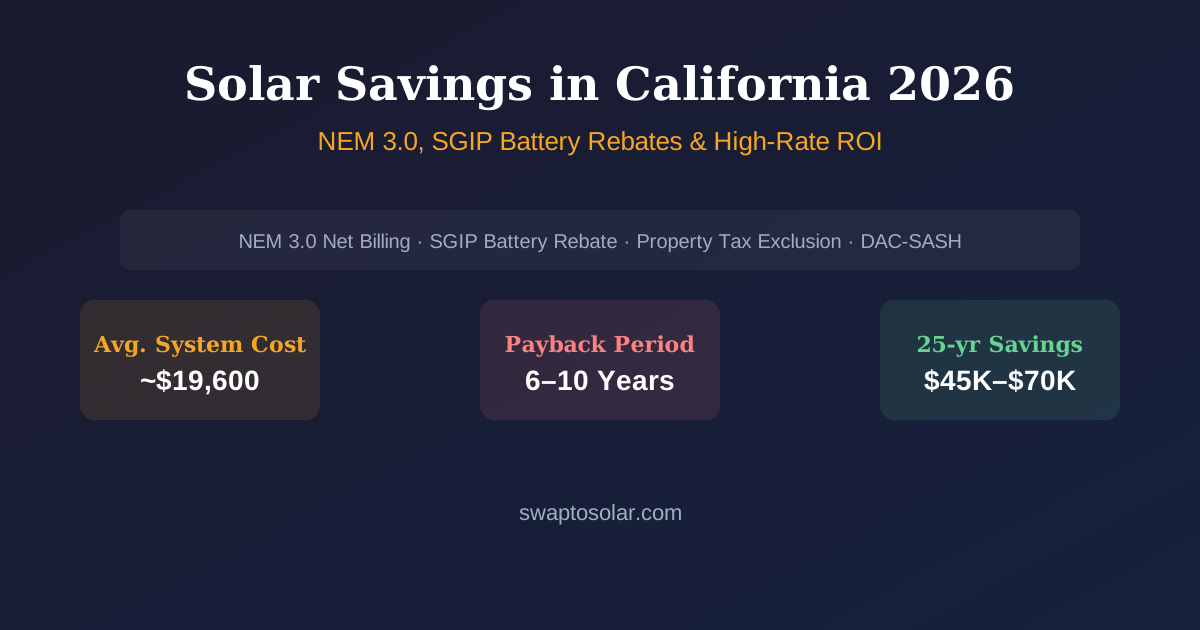
| Avg. 7 kW system cost | ~$19,600 |
| Federal ITC | ❌ Expired Dec 31, 2025 |
| State income tax credit | ❌ None |
| Net metering | ⚠️ NEM 3.0 (Net Billing Tariff) — lower export credits |
| Property tax exclusion | ✅ Active Solar Energy System Exclusion |
| SGIP battery rebate | ✅ Yes (Self-Generation Incentive Program) |
| DAC-SASH (low income) | ✅ Up to ~$3/watt for eligible households |
| Avg. payback period | 6–10 years |
What Solar Incentives Are Available in California in 2026?
The federal 30% residential ITC (Section 25D) expired December 31, 2025 — see our full ITC status guide. California has no statewide solar income tax credit, but it offers several meaningful programs:
1. Active Solar Energy System Exclusion (Property Tax)
California excludes the added value of a solar installation from your property tax assessment. Solar typically adds 3–4% to home value (per Zillow Research), and this exclusion means you won’t pay higher property taxes on that added value.
- On a $700,000 California home, solar can add ~$21,000–$28,000 in value
- At California’s ~1.1% effective property tax rate, that’s roughly $230–$310/year in avoided property taxes
- The exclusion has been extended multiple times — confirm current sunset date with the California State Board of Equalization
2. SGIP — Self-Generation Incentive Program (Battery Storage)
With NEM 3.0 making batteries far more valuable (see below), the SGIP rebate is now one of California’s most important incentives. It provides a rebate for installing battery storage:
- Standard residential SGIP rebates vary by budget category and utility
- Equity and Equity Resiliency tiers offer much higher rebates (up to ~$1,000/kWh) for low-income households and those in high fire-threat districts on a medical baseline
- Administered through your utility — check selfgenca.com for current rebate levels and budget availability
3. DAC-SASH (Disadvantaged Communities — Single-family Affordable Solar Homes)
Low-income homeowners in disadvantaged communities may qualify for upfront incentives of up to roughly $3/watt through DAC-SASH — enough to cover most or all of a system’s cost. Administered by GRID Alternatives.
4. Local & Utility Programs
Some municipal utilities (LADWP, SMUD, Silicon Valley Power) run their own solar and battery rebate programs that are separate from the big three investor-owned utilities. Always check your specific utility.
Understanding NEM 3.0 (the Net Billing Tariff)
This is the single most important thing to understand about California solar in 2026. In April 2023, California transitioned from NEM 2.0 to NEM 3.0, officially the Net Billing Tariff (NBT), for customers of PG&E, SCE, and SDG&E.
| NEM 2.0 (old) | NEM 3.0 (current) | |
|---|---|---|
| Export credit rate | Avoided-cost (“ACC”) — often $0.05–$0.08/kWh | |
| Value of exported power | High | ~75% lower on average |
| Best strategy | Maximize system size | Add a battery, maximize self-consumption |
What this means for you: Under NEM 3.0, exporting excess solar to the grid pays very little. The winning strategy is now solar + battery — store your midday production and use it in the evening instead of selling it cheaply and buying it back at peak rates. This is why SGIP battery rebates matter so much in California now.
Action item: In California, model your savings with a battery included. A solar-only NEM 3.0 system has a longer payback than a solar + storage system that maximizes self-consumption.
California Solar Savings Example (2026)
For a California homeowner with a $250/month electricity bill ($3,000/year) — common given the state’s high rates:
| Amount | |
|---|---|
| 7 kW system gross cost | $19,600 |
| Property tax exclusion (annual) | ~$270/year ongoing |
| SGIP battery rebate (if added) | varies — check current budget |
| Estimated net cost (solar only) | ~$19,600 |
| Annual electricity savings | ~$2,100–$2,600 |
| Payback period | 6–10 years |
| 25-year net savings | ~$45,000–$70,000 |
Estimates based on a 7 kW system producing ~11,600 kWh/year at California’s ~5.7 peak sun hours, with high retail rates driving strong savings. Actual results vary by utility, rate plan, and whether you add storage.
Get your free California solar estimate → Use our Solar Calculator
California Electricity Rates and Solar ROI
California’s high rates are the engine of its solar economics. PG&E, SCE, and SDG&E residential rates frequently exceed $0.30/kWh, and peak time-of-use rates can top $0.50/kWh on summer evenings. Even with NEM 3.0’s reduced export credits, offsetting consumption at these rates produces strong returns — especially with a battery shifting solar into expensive peak hours.
California cities and their solar potential:
| City | Avg. Peak Sun Hours/Day | Notes |
|---|---|---|
| San Diego | 5.8 | SDG&E territory — highest rates in the state |
| Los Angeles | 5.6 | LADWP customers have separate programs |
| Sacramento | 5.5 | SMUD (municipal) — own solar program |
| Fresno | 5.9 | Excellent sun, hot summers, high AC load |
| San Francisco | 5.0 | Fog reduces production modestly |
| Riverside | 5.8 | Strong production, high cooling demand |
Use NREL’s PVWatts Calculator for a production estimate at your specific address.
Municipal Utilities: LADWP, SMUD & Others
If you’re served by a municipal utility (LADWP, SMUD, Silicon Valley Power, Roseville Electric, etc.), you are not on NEM 3.0 — those utilities set their own net metering and rebate rules, many of which are more generous than the big three’s NBT. If you’re an LADWP or SMUD customer, ask your installer to model your specific utility’s solar program, not NEM 3.0.
Solar + Battery Storage in California
Battery storage has shifted from “nice to have” to “central to the financial case” in California:
- NEM 3.0 rewards self-consumption — a battery lets you use your own solar at night instead of selling it cheaply
- SGIP rebates reduce battery cost, especially for equity-tier and fire-risk households
- Public Safety Power Shutoffs (PSPS) make backup power valuable in wildfire-prone regions
- Federal ITC for batteries expired December 31, 2025 — no 30% credit in 2026
For most California homeowners going solar in 2026, the question isn’t whether to add a battery, but how large.
Is Solar Worth It in California Without the Federal ITC?
For most California homeowners, yes — the state’s extremely high electricity rates do much of the heavy lifting that the federal credit used to. Solar is especially strong for:
- High electricity users ($200+/month bills) on PG&E, SCE, or SDG&E
- Homeowners adding a battery to maximize self-consumption under NEM 3.0
- Fire-risk and PSPS-prone areas where backup power has real value
- Eligible low-income households who can stack SGIP equity tiers or DAC-SASH
Where California solar is harder to justify in 2026:
- Very low bills (<$100/month)
- Heavily shaded or north-facing roofs
- Solar-only systems that export most production under NEM 3.0 (add storage instead)
How to Get an Accurate California Solar Quote
Your actual savings depend on:
- Your utility — NEM 3.0 (PG&E/SCE/SDG&E) vs. a municipal utility changes everything
- Your rate plan — time-of-use plans reward battery-shifted solar
- Whether you add storage — strongly recommended under NEM 3.0
- Your roof — south and west-facing roofs pair best with TOU peak pricing
Get quotes from 3+ installers and make sure each one models NEM 3.0 with and without a battery. California installer prices vary 20–30%.
Start with a free estimate → Solar Calculator
Key Takeaways
- California’s high electricity rates (~$0.31/kWh average) drive strong solar savings even without the federal ITC
- NEM 3.0 (Net Billing Tariff) sharply reduced export credits — the winning strategy is now solar + battery for self-consumption
- SGIP provides battery rebates, with much larger amounts for equity-tier and fire-risk households
- Active Solar Energy System Exclusion keeps solar’s added home value off your property tax bill
- Municipal utility customers (LADWP, SMUD) are not on NEM 3.0 — they have separate, often better programs
- Federal ITC expired December 31, 2025 — no 30% credit for 2026 installations
- Avg. payback: 6–10 years; 25-year savings: $45,000–$70,000+ depending on usage and storage
Related Articles
- Solar Savings Calculator by State 2026: Texas, Michigan & New Jersey
- Has the Federal Solar Tax Credit Expired? 2026 ITC Status Update
- Best States for Solar Energy in 2026: Top 10 Ranked
- How Much Do Solar Panels Cost in 2026? State-by-State Guide
- Solar Savings Calculator
Sources: California Public Utilities Commission — Net Billing, Self-Generation Incentive Program (SGIP), California State Board of Equalization, GRID Alternatives DAC-SASH, NREL PVWatts, DSIRE California Incentives, EIA California Electricity Profile.