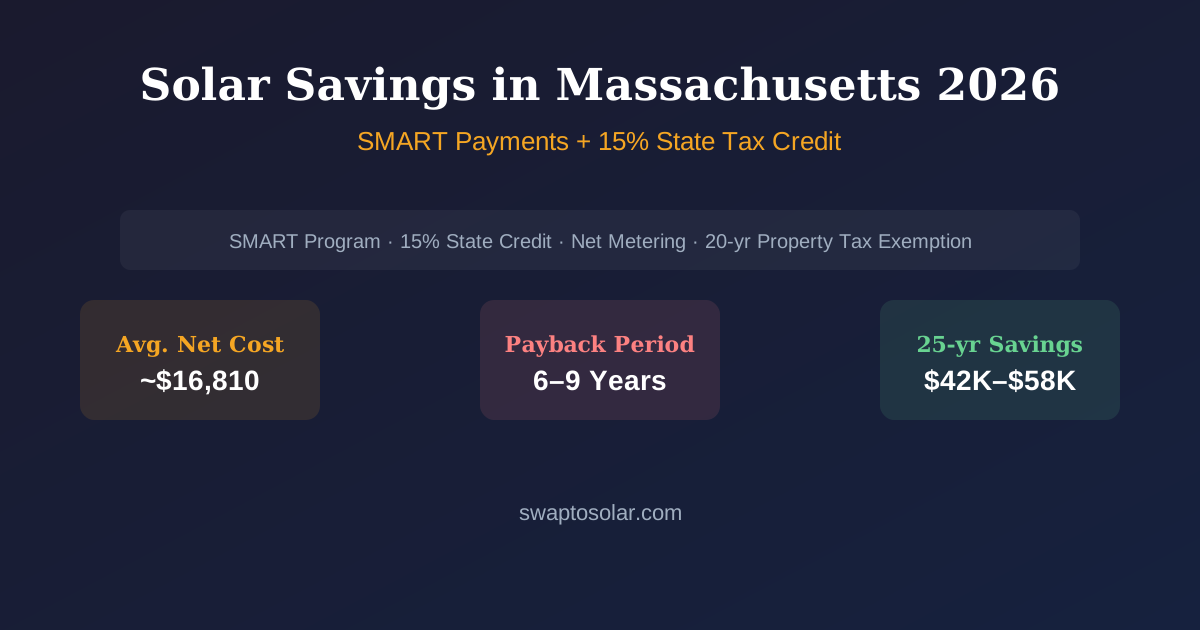
Massachusetts proves you don’t need Sun Belt weather to have outstanding solar economics. With some of the highest electricity rates in the country, a 15% state tax credit, the production-based SMART program, full net metering, and sales and property tax exemptions, Massachusetts delivers short payback periods — typically 6–9 years — even after the federal ITC expired at the end of 2025.
Use our Solar Savings Calculator to get an instant estimate based on your Massachusetts ZIP code and monthly electricity bill.
Massachusetts Solar at a Glance (2026)
| Factor | Massachusetts 2026 |
|---|---|
| Avg. electricity rate | ~$0.29/kWh (among the highest in US) |
| Avg. 7 kW system cost | ~$19,000 |
| Federal ITC | ❌ Expired Dec 31, 2025 |
| MA State Tax Credit | ✅ 15%, up to $1,000 (still active) |
| SMART program | ✅ Per-kWh production payments (10 yr) |
| Net metering | ✅ Available (near-retail credit) |
| Sales tax exemption | ✅ 100% (6.25% saved) |
| Property tax exemption | ✅ 20-year |
| Avg. payback period | 6–9 years |
What Solar Incentives Are Available in Massachusetts in 2026?
The federal 30% residential ITC (Section 25D) expired December 31, 2025 — see our full ITC status guide. Massachusetts’s state stack remains strong:
1. Massachusetts Residential Energy Credit (15%)
This state income tax credit survived the federal expiration. Under Massachusetts law:
- 15% of your system cost, capped at $1,000
- Claimed on Massachusetts Schedule EC with your state return
- Nonrefundable, but unused credit carries forward up to 3 years
- Most systems exceed the threshold to claim the full $1,000
2. SMART Program (Solar Massachusetts Renewable Target)
SMART is the state’s main production incentive. It pays you a fixed per-kWh rate for energy your system generates, for 10 years:
- Administered through your utility (Eversource, National Grid, Unitil)
- The incentive rate depends on your utility’s “block” and system size — rates decline as blocks fill
- A typical residential system can earn meaningful monthly SMART payments on top of bill savings
- Adding a battery can qualify you for a higher SMART rate (energy storage adder)
3. Net Metering
Massachusetts offers net metering that credits exported solar at or near the retail rate for residential systems, offsetting the power you draw at night.
4. 100% Sales Tax Exemption
Solar equipment is exempt from the 6.25% Massachusetts sales tax — roughly $1,190 saved on a $19,000 system.
5. 20-Year Property Tax Exemption
Massachusetts exempts the added value of a residential solar system from property taxes for 20 years — one of the longest exemption windows in the country.
Massachusetts Solar Savings Example (2026)
For a Massachusetts homeowner with a $200/month electricity bill ($2,400/year) — high given the state’s rates:
| Amount | |
|---|---|
| 7 kW system gross cost | $19,000 |
| Sales tax exemption (6.25%) | −$1,190 |
| MA State Tax Credit (15%, capped) | −$1,000 |
| Estimated net cost | ~$16,810 |
| Annual electricity savings | ~$1,900–$2,400 |
| SMART production payments | adds monthly income for 10 years |
| Property tax exemption | 20 years |
| Payback period | 6–9 years |
| 25-year net savings | ~$42,000–$58,000 |
Estimates based on a 7 kW system producing ~8,900 kWh/year at Massachusetts’s ~4.4 peak sun hours, with very high retail rates and SMART payments driving strong returns. Actual results vary by utility and SMART block.
Get your free Massachusetts solar estimate → Use our Solar Calculator
Massachusetts Electricity Rates and Solar ROI
Massachusetts rates average ~$0.29/kWh — roughly double the national average — and winter supply rates can spike even higher. Despite getting only ~4.4 peak sun hours/day, those extreme rates plus SMART production income produce some of the shortest payback periods in the country. Every kWh your panels make offsets very expensive grid power.
Massachusetts areas and their solar potential:
| Area | Avg. Peak Sun Hours/Day | Notes |
|---|---|---|
| Cape Cod / Southeast | 4.6 | Best sun in the state |
| Boston / Greater Boston | 4.3 | Eversource territory, high rates |
| Worcester / Central | 4.3 | National Grid territory |
| Springfield / Western | 4.2 | Eversource West, snow load matters |
Use NREL’s PVWatts Calculator for a production estimate at your specific address.
How SMART Pays You (Plus Net Metering)
Like New Jersey, Massachusetts lets you benefit twice:
- Net metering offsets the grid power you’d otherwise buy at ~$0.29/kWh
- SMART pays you a fixed per-kWh incentive on everything your system produces, for 10 years
The combination of extremely high avoided rates and a production payment is what makes Massachusetts solar so financially attractive despite its northern latitude and cloudy winters.
Tip: Because SMART rates decline as each utility block fills, installing sooner generally locks in a higher incentive rate for the full 10-year term.
Solar + Battery Storage in Massachusetts
- The SMART energy storage adder can increase your per-kWh incentive when you pair solar with a battery
- Storage provides backup during Nor’easters and winter outages
- Federal ITC for batteries expired December 31, 2025 — no 30% federal credit in 2026
- High winter rates make battery-shifted solar more valuable than in low-rate states
Is Solar Worth It in Massachusetts Without the Federal ITC?
For most Massachusetts homeowners, yes — the state’s sky-high rates plus SMART do the heavy lifting the federal credit used to. Solar is especially strong for:
- Eversource and National Grid customers with $150+/month bills
- Homeowners who lock in a high SMART block by installing sooner
- Those adding a battery to capture the storage adder and winter resilience
- Long-term owners who benefit from the 20-year property tax exemption
Where Massachusetts solar is harder to justify in 2026:
- Low bills (<$90/month)
- Heavily shaded or north-facing roofs (common with mature New England tree cover)
- Very low state tax liability (limits use of the 15% credit, though it carries forward 3 years)
How to Get an Accurate Massachusetts Solar Quote
Your actual savings depend on:
- Your utility and SMART block — Eversource, National Grid, and Unitil differ, and rates decline over time
- Whether you add storage — the SMART storage adder can boost your incentive
- Your winter usage and rate — high winter rates improve ROI
- Your roof — south-facing unshaded roofs produce the most
Get quotes from 3+ installers and require each to itemize SMART payments, net metering, and the 15% state credit. Massachusetts prices vary 15–25%.
Start with a free estimate → Solar Calculator
Key Takeaways
- Massachusetts’s 15% state tax credit (up to $1,000) is still active — claimed on Schedule EC, carries forward 3 years
- SMART pays a fixed per-kWh production incentive for 10 years — and a storage adder rewards adding a battery
- Among the highest electricity rates in the US (~$0.29/kWh) means strong savings despite limited sun
- 100% sales tax exemption (~$1,190) and a 20-year property tax exemption add automatic value
- Federal ITC expired December 31, 2025 — no 30% federal credit for 2026 installations
- Avg. payback: 6–9 years; 25-year savings: $42,000–$58,000
- Install sooner to lock in a higher SMART block rate for the full 10-year term
Related Articles
- Solar Savings Calculator by State 2026: Texas, Michigan & New Jersey
- Has the Federal Solar Tax Credit Expired? 2026 ITC Status Update
- Best States for Solar Energy in 2026: Top 10 Ranked
- How Much Do Solar Panels Cost in 2026? State-by-State Guide
- Solar Savings Calculator
Sources: Massachusetts Schedule EC (Residential Energy Credit), MA SMART Program (DOER), MA Net Metering, NREL PVWatts, DSIRE Massachusetts Incentives, EIA Massachusetts Electricity Profile.