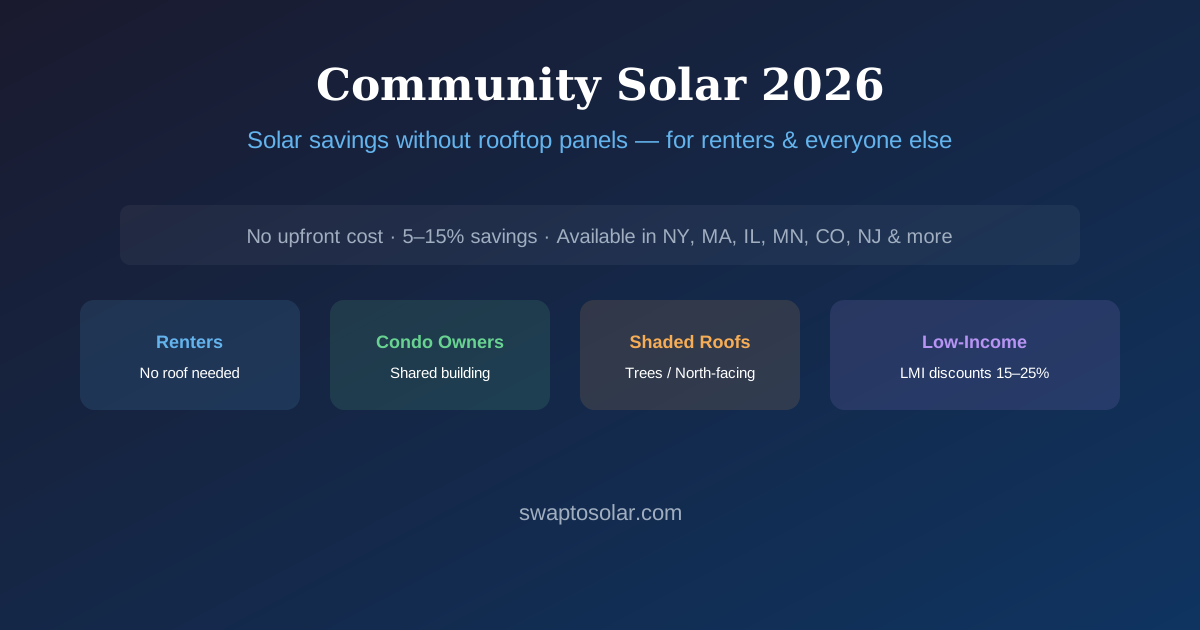
Not everyone can install solar panels on their roof. Renters, condo owners, homeowners with shaded or north-facing roofs, and those who can’t afford the upfront cost are often left out of rooftop solar.
Community solar — also called shared solar or solar gardens — solves this. You subscribe to a share of a local solar farm, and the electricity it produces is credited directly to your utility bill. No panels on your roof, no installation, no ownership required.
Here’s everything you need to know about community solar in 2026.
What Is Community Solar?
A community solar project is a medium-to-large solar array (typically 1–5 MW) built in your area and connected to the local utility grid. Households and businesses subscribe to a portion of the project’s output — a “share” — and receive credits on their monthly electricity bill for the power their share produces.
How the bill credit works:
- The solar farm generates electricity
- Your share produces a certain number of kWh each month
- Your utility applies a credit to your bill at a per-kWh rate (usually close to retail)
- If the credit exceeds your bill, it rolls forward to the next month in most states
You pay a subscription fee to the community solar provider — typically slightly lower than what you’d pay the utility for the same electricity. The difference is your savings.
Typical savings: 5–15% on the portion of your bill covered by the subscription.
Who Is Community Solar For?
Community solar works best for:
- Renters — no roof ownership required
- Condo and apartment dwellers — shared roofs with no individual control
- Homeowners with shaded or unsuitable roofs — north-facing, heavy tree cover, or complex roof shapes
- Homeowners who want solar benefits without a large upfront payment — most subscriptions are month-to-month or have short terms
- Low-to-moderate income (LMI) households — many states require community solar programs to reserve 20–51% of capacity for LMI subscribers, often at deeper discounts
How Does Community Solar Work, Step by Step?
- Find a project in your area — Search by ZIP code on EnergySage Community Solar or EnergySage’s marketplace
- Choose a subscription size — Typically matched to 90–100% of your monthly electricity usage
- Sign a subscriber agreement — Usually 1, 5, or 20 years; many short-term options exist
- The utility connects you — The solar provider notifies your utility; credits start appearing on your bill
- Receive monthly bill credits — Credits reduce your electricity bill automatically; no action required
- Pay the subscription — Either to the solar provider directly or through your utility bill
No equipment, no installation, no maintenance — the project developer handles everything.
Community Solar vs. Rooftop Solar: Which Is Better?
| Community Solar | Rooftop Solar | |
|---|---|---|
| Who can use it | Renters, any homeowner | Homeowners with suitable roofs |
| Upfront cost | Usually $0 | $15,000–$25,000 (or financed) |
| Federal ITC | ❌ Not for subscribers | ❌ Expired Dec 31, 2025 (residential) |
| Savings | 5–15% on subscribed portion | 70–100% of electricity bill |
| Payback period | Immediate (monthly savings) | 10–15 years |
| Portability | Cancel/transfer when you move | Stays with the house |
| Commitment | Often month-to-month | 25-year system lifetime |
| Best for | Renters, shaded roofs, LMI | Homeowners, long-term ownership |
Bottom line: Rooftop solar delivers higher long-term savings if you own your home and have a suitable roof. Community solar delivers immediate, lower savings with no commitment — and it’s the only solar option for renters.
Which States Have Community Solar Programs in 2026?
Community solar availability varies significantly by state. Programs exist where state law explicitly enables them and utilities are required to allow interconnection and bill crediting.
States with Active Community Solar Programs
New York — One of the most developed community solar markets. NY-Sun incentives have driven significant capacity. LMI subscribers get enhanced credits. Managed by NYSERDA.
Massachusetts — Solar Massachusetts Renewable Target (SMART) program supports community solar with long-term incentive payments. Strong LMI provisions.
Illinois — Illinois Shines program (formerly Adjustable Block Program) includes community solar with Solar Renewable Energy Credits (SRECs) sold to utilities.
Minnesota — One of the earliest and largest community solar markets. Xcel Energy’s Solar*Rewards Community program has thousands of subscribers.
Maryland — Community Energy Facilities program allows community solar with utility bill credits. LMI carve-out required.
New Jersey — Community Solar Energy Program (CSEP) launched in 2019 and has expanded significantly. Combines with SuSI program in some cases.
Colorado — Xcel Energy, Black Hills Energy, and cooperative utilities offer community solar. Colorado’s community solar market is one of the fastest-growing in the Mountain West.
Maine — Community Net Energy Billing (CNEB) program allows virtual net metering for community solar projects.
Oregon — Shared Renewables Program (SRP) through PGE and Pacific Power allows bill credits for community solar subscribers.
Virginia — Community Solar Pilot Program through Dominion Energy and Appalachian Power.
Hawaii — Community-Based Renewable Energy (CBRE) program administered by HECO.
California — Green Tariff programs and VNEM (Virtual Net Energy Metering) enable some community solar access, though the market is less developed than rooftop solar.
States Without Community Solar (or Limited Access)
Texas, Florida, Georgia, and most Southeast states do not have mandatory community solar programs. Some utilities in these states offer voluntary “green tariff” or “solar subscription” programs, but they are not true community solar with bill credits.
Check current availability in your state: NRDC Community Solar Map and EnergySage Community Solar show project availability by ZIP code.
Low-Income Community Solar: Expanded Access in 2026
Federal and state policies have increasingly focused on making community solar accessible to low-to-moderate income (LMI) households:
Federal: The Inflation Reduction Act’s Low-Income Communities Bonus Credit (Section 48(e)) provides additional tax credits to community solar projects that serve LMI subscribers — incentivizing developers to build LMI-focused projects.
State requirements: Many state programs require 20–51% of community solar capacity to be reserved for LMI households:
- New York: 30% LMI carve-out with enhanced bill credits
- Illinois: 25% LMI carve-out with additional SREC incentives
- Maryland: 30–40% LMI requirement
- Colorado: Xcel Energy’s program includes LMI-specific tracks
What this means for LMI subscribers: Deeper discounts (often 15–25% vs. 5–10% for standard subscribers), sometimes with no credit check or minimum income requirement. Income verification is typically through utility billing data.
How Much Does Community Solar Cost?
Most community solar subscriptions have no upfront cost. You pay a monthly subscription fee that is structured to be less than what you’d pay the utility for the same electricity.
Typical pricing structures:
-
Fixed discount: You pay X% less than the utility rate for the electricity your share produces (e.g., 10% discount on 500 kWh/month = ~$8–12/month savings)
-
Fixed per-kWh rate: You pay a set rate (e.g., $0.11/kWh) vs. the utility rate ($0.14/kWh) — saving the difference
-
Bill credit model: Credits automatically appear on your utility bill; you pay the subscription provider separately
Watch out for:
- Long-term contracts (5–20 years) that don’t allow easy exit if you move
- Rate escalators — some contracts include annual rate increases of 1–3%
- Savings guarantees — some providers guarantee minimum savings; most do not
Best practice: Choose month-to-month subscriptions or short-term contracts where possible. Read the exit/transfer clause carefully before signing.
Community Solar and the Federal ITC
Subscribers do not claim any federal tax credit for community solar — neither the old Section 25D (expired) nor any other residential credit applies to subscribers.
The project developer (a commercial entity) may claim the commercial Section 48E Investment Tax Credit on the solar array itself. This helps them offer competitive subscriber rates, but the credit flows to the developer, not to you.
This is the same model as solar leases and PPAs for rooftop solar — the developer claims the credit and passes some savings to subscribers through lower rates.
How to Find Community Solar in Your State
- EnergySage Community Solar: community.energysage.com — enter your ZIP code to find available projects
- DSIRE database: dsireusa.org — search your state for community solar programs and policies
- Your utility’s website: Many utilities list community solar options or partner programs
- State energy office: Your state’s renewable energy office may maintain a list of approved projects
Key Takeaways
- Community solar lets renters, condo owners, and anyone access solar savings without rooftop panels
- Typical savings: 5–15% on the portion of your electricity bill covered by your subscription
- No upfront cost in most cases — month-to-month options available
- Best markets in 2026: New York, Massachusetts, Illinois, Minnesota, Colorado, New Jersey
- LMI programs offer deeper discounts (15–25%) in many states — check eligibility
- Subscribers don’t claim the federal ITC — the developer does; the credit expired for residential rooftop owners Dec 31, 2025 but the commercial credit for developers remains
- Read contract terms carefully — avoid long-term contracts with no easy exit
- Find projects at community.energysage.com or dsireusa.org
Related Articles
- Has the Federal Solar Tax Credit Expired? 2026 ITC Status Update
- Best States for Solar Energy in 2026: Top 10 Ranked
- Solar Savings Calculator by State 2026: Texas, Michigan & New Jersey
- How to Switch to Solar: A Step-by-Step Guide for Homeowners
- How Much Do Solar Panels Cost in 2026? State-by-State Guide
- Solar Savings Calculator
Sources: NRDC Community Solar 101, DSIRE Community Solar Policies, EnergySage Community Solar, NREL Community Solar, DOE Community Solar, IRS Section 48(e) Low-Income Bonus Credit.