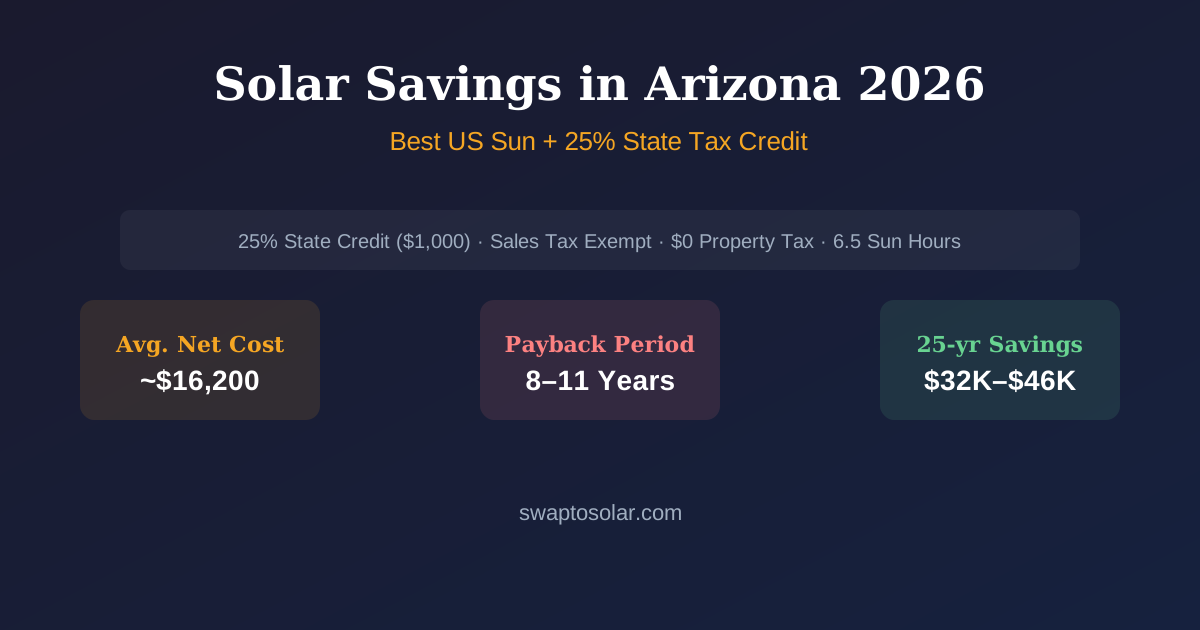
Arizona gets more sunshine than almost anywhere in the country — and in 2026 it still offers a state solar tax credit that survived the federal ITC expiration. With 6+ peak sun hours a day, an Arizona 25% credit (up to $1,000), sales and property tax exemptions, and high summer cooling bills, Arizona remains a strong solar state even after the federal 30% credit ended.
Use our Solar Savings Calculator to get an instant estimate based on your Arizona ZIP code and monthly electricity bill.
Arizona Solar at a Glance (2026)
| Factor | Arizona 2026 |
|---|---|
| Avg. electricity rate | ~$0.14/kWh |
| Avg. 7 kW system cost | ~$18,200 |
| Federal ITC | ❌ Expired Dec 31, 2025 |
| AZ State Tax Credit | ✅ 25%, up to $1,000 (still active) |
| Sales tax exemption | ✅ Yes |
| Property tax exemption | ✅ Solar adds $0 to assessed value |
| Net metering | ⚠️ Net billing — export rate below retail |
| Avg. peak sun hours | 6.0–6.6/day (best in US) |
| Avg. payback period | 8–11 years |
What Solar Incentives Are Available in Arizona in 2026?
The federal 30% residential ITC (Section 25D) expired December 31, 2025 — see our full ITC status guide. Arizona’s state incentives remain in place:
1. Arizona Residential Solar Energy Tax Credit (25%)
This state credit survived the federal expiration. Under Arizona Revised Statutes §43-1083:
- 25% of your system cost, capped at $1,000
- Claimed on Arizona Form 310 with your state income tax return
- Nonrefundable, but unused credit carries forward up to 5 years
- Most systems easily exceed the threshold to claim the full $1,000
2. Solar Equipment Sales Tax Exemption
Arizona exempts solar energy devices from the state transaction privilege (sales) tax. On an $18,200 system, that’s roughly $1,000+ saved, depending on local rates.
3. Energy Equipment Property Tax Exemption
Under A.R.S. §42-11054, solar energy devices are assessed at zero added value for property tax purposes. Your home’s value rises with solar, but your property tax bill does not — a clean, automatic benefit.
4. Utility Programs (APS, SRP, TEP)
Arizona’s major utilities — Arizona Public Service (APS), Salt River Project (SRP), and Tucson Electric Power (TEP) — each set their own solar export and rate rules:
- APS and TEP use an export rate (net billing) that credits exported solar below the retail rate, and it steps down over time
- SRP places solar customers on a specific time-of-use demand rate plan — modeling your bill on SRP’s solar plan is essential
- Some utilities have offered battery storage incentives — check current availability
Understanding Net Billing in Arizona
Arizona moved away from full retail net metering years ago. Today, most utilities use net billing with an export rate:
| Full Net Metering (old) | Net Billing (current AZ) | |
|---|---|---|
| Export credit | Full retail (~$0.14/kWh) | Export rate (~$0.07–$0.09/kWh) |
| Trend | Stable | Steps down annually |
| Best strategy | Maximize system size | Maximize self-consumption / add battery |
What this means for you: Because exported power is credited below retail, the most valuable solar in Arizona is the energy you use directly during the day (running AC) or store in a battery for the evening. Size your system to your daytime usage rather than to export as much as possible.
Arizona Solar Savings Example (2026)
For an Arizona homeowner with a $170/month electricity bill ($2,040/year) — high summer AC drives this:
| Amount | |
|---|---|
| 7 kW system gross cost | $18,200 |
| Sales tax exemption | −$1,000 |
| AZ State Tax Credit (25%, capped) | −$1,000 |
| Estimated net cost | ~$16,200 |
| Annual electricity savings | ~$1,500–$1,900 |
| Property tax exemption | $0 added assessed value |
| Payback period | 8–11 years |
| 25-year net savings | ~$32,000–$46,000 |
Estimates based on a 7 kW system producing ~12,800 kWh/year at Arizona’s excellent ~6.3 peak sun hours. Actual results vary by utility and rate plan.
Get your free Arizona solar estimate → Use our Solar Calculator
Arizona Electricity Rates and Solar ROI
Arizona’s average rate of ~$0.14/kWh is near the national average, but the state’s enormous sun resource means systems produce more energy per kilowatt installed than almost anywhere else. The catch is net billing — exported power earns less — so the homeowners who win biggest are those with high daytime AC loads that consume solar as it’s produced.
Arizona cities and their solar potential:
| City | Avg. Peak Sun Hours/Day | Notes |
|---|---|---|
| Phoenix | 6.5 | Massive AC load, APS or SRP territory |
| Tucson | 6.4 | TEP territory, excellent production |
| Yuma | 6.6 | One of the sunniest cities in the US |
| Flagstaff | 6.0 | Cooler, snow load considerations |
| Mesa / Scottsdale | 6.5 | SRP demand-rate modeling important |
Use NREL’s PVWatts Calculator for a production estimate at your specific address.
APS vs. SRP vs. TEP: Know Your Utility
Your utility shapes your Arizona solar economics more than almost any other factor:
- APS: net billing with a declining export rate; multiple rate plans — pick the one best for solar
- SRP: not regulated by the Arizona Corporation Commission; uses specific solar time-of-use demand plans with a demand charge. Battery storage often pairs well to manage demand peaks
- TEP: net billing with an export rate similar to APS
Always have your installer model your bill on your specific utility’s solar rate plan — a generic estimate can be misleading in Arizona.
Solar + Battery Storage in Arizona
Storage is increasingly central to Arizona solar value:
- Net billing rewards self-consumption — a battery stores midday solar for expensive evening hours
- SRP demand charges can be reduced with a well-managed battery
- Backup power matters during monsoon-season outages and extreme heat events
- Federal ITC for batteries expired December 31, 2025 — no 30% federal credit in 2026
Is Solar Worth It in Arizona Without the Federal ITC?
For most Arizona homeowners, yes — the unbeatable sun plus the surviving state credit keep returns solid. Solar is especially strong for:
- High summer AC users with $150+/month bills
- Homeowners who self-consume most of their production (daytime usage or a battery)
- Phoenix, Tucson, and Yuma with 6.4+ peak sun hours
- SRP customers who add a battery to manage demand charges
Where Arizona solar is harder to justify in 2026:
- Low bills (<$90/month)
- Systems oversized for export under net billing
- Shaded roofs or significant east/west-only orientation
How to Get an Accurate Arizona Solar Quote
Your actual savings depend on:
- Your utility and rate plan — APS, SRP, and TEP differ substantially (especially SRP’s demand charges)
- Your export rate — net billing credits exported power below retail
- Your daytime usage — high AC load improves self-consumption and ROI
- Whether you add a battery — often worthwhile under net billing and SRP demand rates
Get quotes from 3+ installers and require each to model your specific utility rate plan. Arizona prices vary 15–25%.
Start with a free estimate → Solar Calculator
Key Takeaways
- Arizona’s 25% state tax credit (up to $1,000) is still active — claimed on Form 310, carries forward 5 years
- Best sun in the US (6.0–6.6 peak hours) means high production per kW installed
- Net billing credits exported power below retail — size to your daytime usage or add a battery
- Sales tax exemption and $0 property tax assessment on solar are automatic
- SRP customers face demand-rate plans where battery storage often pays off
- Federal ITC expired December 31, 2025 — no 30% federal credit for 2026 installations
- Avg. payback: 8–11 years; 25-year savings: $32,000–$46,000
Related Articles
- Solar Savings Calculator by State 2026: Texas, Michigan & New Jersey
- Has the Federal Solar Tax Credit Expired? 2026 ITC Status Update
- Best States for Solar Energy in 2026: Top 10 Ranked
- How Much Do Solar Panels Cost in 2026? State-by-State Guide
- Solar Savings Calculator
Sources: Arizona Revised Statutes §43-1083 / Form 310, A.R.S. §42-11054 (Property Tax), Arizona Corporation Commission, NREL PVWatts, DSIRE Arizona Incentives, EIA Arizona Electricity Profile.